

In 1995 Daniel Goleman launched his book Emotional Intelligence which soon permeated our thinking in education, business, and culture. His premise: our emotional quotient is more important than our intelligence for future success.
Goleman defines emotional intelligence in a description in a recent podcast on the Good Life Project as,
“…a different way of being smart….What kind of person are you? Are you self-aware? Can you empathize? Can you put that together in relationship and have strong connections?…It’s a key to success in life.”
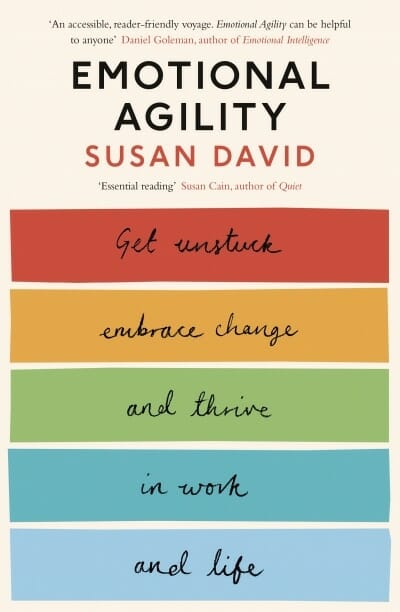
Based on Goleman’s thesis and our own common sense, we launched social-emotional learning programs in schools. Google drank the Kool-Aid and developed an emotional intelligence and mindfulness program for their campus. More books were written.One gap is that we may still be advancing children’s intellectual and physical acumen through extra-curricular activities when really unstructured play and problem-solving might be the most supportive activities for emotional intelligence.In the meantime, our technological advancements have created more isolation, loneliness, anxiety, and depression.So, just over two decades later, Dr. Susan David, a psychology researcher from Harvard published Emotional Agility, to help us unpack the competencies we need to cultivate.I first heard about her book on a podcast with Rob Bell which describes her wildly popular article in the Harvard Business Review. Her book captured me in the first few pages because she used a keyword for me: thrive. David describes the world we live in as it contrasts to “the world we want to live in, the world where we could truly thrive.” I’m riveted. I want us all to thrive, for the sake of our children. Yet, I find myself trapped by vicious patterns of emotions and only taste the freedom emotional agility might bring.
[fusion_builder_container hundred_percent=”yes” overflow=”visible”][fusion_builder_row][fusion_builder_column type=”1_1″ background_position=”left top” background_color=”” border_size=”” border_color=”” border_style=”solid” spacing=”yes” background_image=”” background_repeat=”no-repeat” padding=”” margin_top=”0px” margin_bottom=”0px” class=”” id=”” animation_type=”” animation_speed=”0.3″ animation_direction=”left” hide_on_mobile=”no” center_content=”no” min_height=”none”]
[/fusion_builder_column][fusion_builder_column type=”1_1″ background_position=”left top” background_color=”” border_size=”” border_color=”” border_style=”solid” spacing=”yes” background_image=”” background_repeat=”no-repeat” padding=”” margin_top=”0px” margin_bottom=”0px” class=”” id=”” animation_type=”” animation_speed=”0.3″ animation_direction=”left” hide_on_mobile=”no” center_content=”no” min_height=”none”]
What is emotional agility?
Emotional agility is the capacity to hold difficult emotions and thoughts loosely, facing them courageously and compassionately, and then moving past them in order to maintain behaviours in alignment with our intentions and values.Emotional agility is a keystone of intimate relationships and essential for creating community. My therapist describes it as, “getting comfortable with the uncomfortable” in order to be in a constructive and healthy place.I confess, based on my own life experiences, I have some well-worn destructive tendencies when I move into fight-flight. So, I am deeply curious about how to Learn Forward in this area of selfhood and belonging. I am hopeful my vulnerable journey will serve teachers, parents, and children.David describes a four-step process for practising emotional agility:
- Recognize your patterns.
- Label your thoughts and feelings for the purpose of understanding them as data.
- Mindfully and compassionately accept those feelings, instead of controlling them.
- Make values-based choices about your behaviour.
In steps 2-3, we are deliberately working to create some space between stimulus and response. When something triggers us, we want to breathe before choosing our response. Naming and accepting our reality can be practised as breathing. It is a paradox, we cannot change our circumstance until we accept it. We stop trying to control and find peace in-the-moment.Emotional agility is the wave of the future because “Life’s beauty is inseparable from its fragility.”So, in our classrooms and homes, I encourage us all to begin naming feelings and compassionately accepting them. It will take a tremendous amount of courage. It will be a hero’s journey. We will enter into the shadow of human fragility. But, from there we find the path to the light.
How does emotional agility look and sound in our nests?
Today when my daughter couldn’t affix the elbow joint of her GoldieBlox to the axel of her car, she threw them to the ground in a rage. My husband responded quietly, “I can see you’re frustrated” as I moved in to rub her back. In just a few moments she had found equanimity and continued in her play. Within minutes her car was assembled.One weekend, we might be successful and the other we fail. What I know for sure is…“We will keep doing what we can, with what we have, where we are” to support the development of emotional agility in our lives and the lives of our children.For the sake of the children,Karine
[/fusion_builder_column][/fusion_builder_row][/fusion_builder_container]